
Introduction
The Bute Red Squirrel Project has found several areas on Bute where red squirrels are living. But it seems that something is holding back our island squirrel population. Why aren’t our red squirrels as common as they are on the mainland in Argyll?
The most likely reasons include:
- Food supply. They don’t have enough food, or a big enough range of food sources, to see them through the whole year.
- Fragmented habitat. We know from other conservation studies and other species that fragmented habitats can be a big problem. If our red squirrels cannot move easily between woodlands, this restricts their access to a wide variety of food and also prevents them finding other squirrels. The population becomes inbred and weakened.
- We have an island population of squirrels. It could have been founded by just a handful of individuals or even a single pregnant female. A small population of closely related squirrels might not be very successful at reproducing.
The challenge of finding out more about Bute’s red squirrels was taken up by Dr Rebecca Synnott from the South East Technical University (SETU) in Ireland. She has the backing of Research Ireland and the Vincent Wildlife Trust for this two-year post-doctoral study. She will be analysing the DNA of our squirrels, which will help to answer questions such as:
- How closely related are our red squirrels? Are they closely inbred?
- How much movement of squirrels is there between woodlands on Bute? If the squirrels in different woodlands are genetically distinct, this will tell us that they cannot move between woodlands to reach a variety of food sources and find other unrelated squirrel to breed with.
- Where did our red squirrels come from? DNA analysis can tell us if they were Argyll squirrels that crossed the Kyles of Bute or if they are more exotic squirrels that were introduced here.
- Do our squirrels carry any of the major squirrel diseases? The DNA analysis will show if there are traces of genetic material from viruses or bacteria that cause diseases in red squirrels.
An important feature of this study is that it should provide us with information to help the practical work of the conservation of our red squirrels. It’s more than just an academic study.
But first we need those DNA samples from our red squirrels.
What we are doing
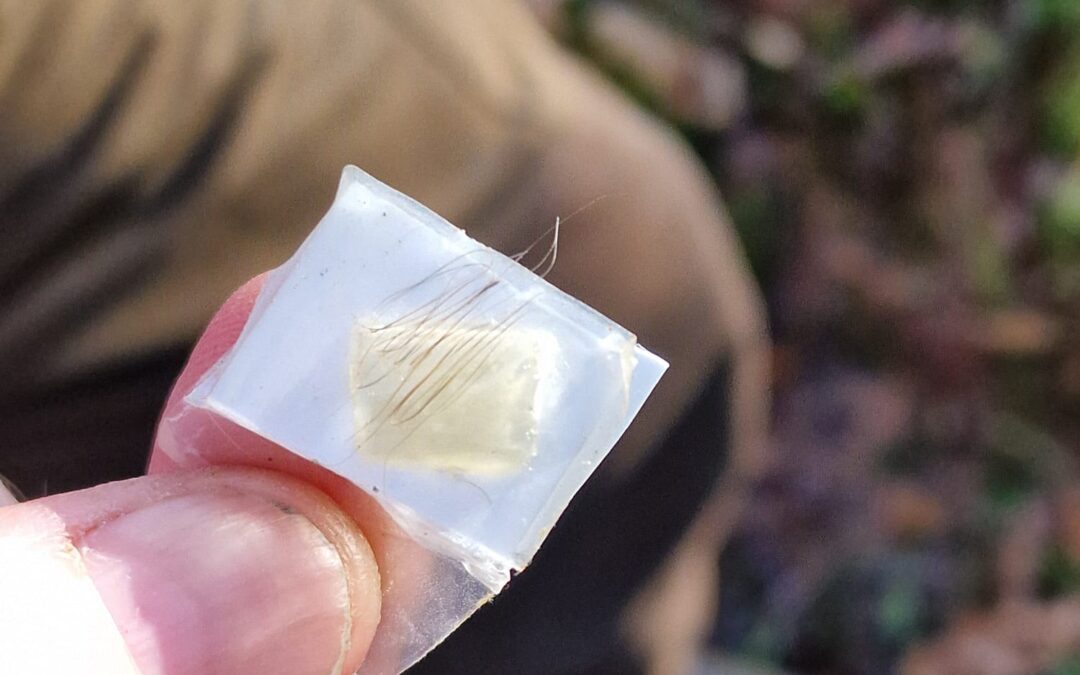
We are using hair tubes as a ‘minimally invasive’ method of collecting red squirrel DNA. The hair tubes are just lengths of plastic drainpipe, closed off at one end and attached to trees for about eight weeks. They are baited with hazelnuts, sunflower seeds and peanuts. The squirrels enter the tubes to collect the food and on the way out they leave a few strands of hairs on a sticky patch that we have placed inside the tube. On the ends of the hairs are some hair follicles and the cells in those follicles yield the DNA that Rebecca Synnott needs for her study.
We know from other studies that squirrels will return to the tubes and also visit multiple tubes. So they clearly view the exchange of a few hairs in return for a snack as a good deal. It’s a clever and low-cost technique and it is virtually stress-free for the squirrels.
How we do it
- For each site we will put out 10-20 baited hair tubes in a grid pattern at 100 metre intervals. This started at the end of March 2025.
- We return each week to collect any hair samples, fit new sticky pads and refresh the food in the tubes.
- After eight weeks we remove the hair tubes.
- We will be repeating this at various sites across Bute until September.
The hair samples go into a freezer to preserve the DNA and will be sent by courier to Ireland. Rebecca Synnott can then start the painstaking laboratory work of extracting and analysing the DNA. This work could take a further six months.
I would like to acknowledge the enormous amount of work and dedication from everyone involved in this project. It sounds easy to simply place 10-20 hair tubes in a woodland. But when that woodland is on a 30 degree slope and there are no paths and it’s pouring with rain and you have to go out again next week and the week after and the week after that, it takes commitment. There’s also the hours required to turn drainpipe into hair tubes and create 300 sticky patches that are just the right design to collect squirrel hairs. If only we could explain all this to our squirrels, they would surely be very grateful.
More information
Rebecca Synott:
- https://www.researchgate.net/profile/Rebecca-Synnott
- Rebecca’s appearance on Autumnwatch in 2021: https://www.youtube.com/watch?v=C25nCAGVhrs
- Presentation by Rebecca in 2012 on her PhD research: https://www.youtube.com/watch?v=2-qkzGohs-0
- Her mentor at SETU is Denise O’Meara – https://www.setu.ie/staff/denise-omeara
SETU: https://www.setu.ie
Research Ireland:
- https://www.researchireland.ie/
- Announcement of funding of the Bute project (scroll down to find our project): https://www.researchireland.ie/news/enterprise-funding
Vincent Wildlife Trust: https://www.vwt.org.uk/